Thursday, 4 April 2013

Heygate prints

Below are some examples of the prints produced at Heygate Estate/screen-printing workshop.
paper stencilled type

collaborative print
masking
textural patterns/stencil
collaborative print

mixed media
direct drawing on screen

multiple layers & paper stencil

paper stencil

Wednesday, 13 March 2013

Screen printing in the Heygate/reflections


print on the surfaces (pic Lizzie)


Some reflections after the day:
 I've learnt  that your environment really does make a difference to what work you come up with, and how it informs what you already have in mind. (Shuhena)

It made me travel to another epoque and imagine the lives of the people who used to live there. I could really feel those lives around me while printing. (Maria)

On reflection, Hampstead was about using what was available in environment such as direct mud prints, where as at Heygate we responded to the environment through a medium. (William)

'A mistake' can be turned into a good piece of work. If I was working in the studio, I'd start to work again but working outside required me to respond quickly (Jenny) 
...To accept spontaneity and unplanned developments and accidents as a creative benefit (Philly) 

The main thing I learned was that screen printing doesn't have to be kept inside the studio. And being outside really made my work more spontaneous and responsive to the slightly eerie atmosphere of the estate. (Lizzie) 

Heygate Estate printing session (pic Lizzie)
stencil printing
I'm really interested in repeating the experience, but this time only using natural dyes and things you find in the environment to make your patterns and final prints and somehow combining the two workshop experiences together in order to take with you for a printing day just few essential things like the screen, maybe a pre-prepared natural colour and some paper to make the experience even more interesting and unpredictable. (Nina)
The freedom to print anywhere such as the walls or the floors really appealed to me, I really enjoyed getting stuck in with different colours and trying out different techniques (Hector).

I learnt about colour, awareness of the heygate estate's story and the people that live(d) there, street art ideas, a sense that any area can be transformed very quickly, the ability of nature to 'reclaim' manmade objects when left alone (Oliver).


Watch Barbara discuss the project fro Green Week at LCC
http://vimeo.com/61214030#
Collective print (pic Lizzie)


(Pics by Philly)

Tuesday, 5 March 2013

Print 2: Heygate Estate


The Heygate Estate is our venue for print 2 designed by Tim Tinker. Completed in 1974 which housed
3,000 people as a grand social housing project. Today sees it boarded up in preparation for the regeneration roll out. 3 people still live here and an abundance of wildlife has returned.

http://www.guardian.co.uk/society/2011/mar/04/death-housing-ideal

Thursday, 28 February 2013

Recycled Screen Making

Making screens from recycled mesh and old picture frames was the order of our evening session (27.2.13). The group brought in an array of found, discarded and made wooden frames. A few hands made lighter work of hand stretching the used mesh. Staple gun, gaffer tape, brute force and patience helped create over 8 frames in preparation for 6th March print session.

recycled mesh (used or torn)

many hands make light work!
Hector and screens

Thursday, 21 February 2013

Drawing in Arctic Water (Tracey Rowledge)

Artist & bookbinder Tracey Rowledge's project with Cape farewell

'Drawing in Arctic Water' shows us how the environment and materials fuse together.


Article written by Nancy Campbell (editor of Printmaking Today)
"It's a preoccupation - how and why we make marks, and what they mean to me and to other people. A mark always evokes an emotional response," Rowledge says. She rescues notes on scraps of paper discarded in London's gutters, and gold tools them onto leather, the gilt impression true to each scribble and smudge. Bookbinding enables her to use "a non-gestural process to create something that evokes movement and spontaneity - and yet it's completely embedded in the tradition and processes of gold tooling. I love that extreme play."

http://www.huffingtonpost.co.uk/nancy-campbell/post_4220_b_2299181.html 
http://www.traceyrowledge.co.uk/contents.asp
http://www.capefarewell.com
 www.printmakingtoday.co.uk

Thursday, 14 February 2013

Screen Printing (make your own)

The second of the workshops is in planning. The session will run on Wednesday 5 March 2013 at a location within the Heygate Estate, SE1. Our aims for the session are to use screen printing, paper stencils, direct marking/painting onto screens and print within the environment. We will aim to utilises materials that are reflective and respond to the location. We aim to use non toxic methods and water based, temporary medium. We also intend to create our own screens from waste materials.

This site shows you how to make a screen with an old picture frame.
http://www.printcutsew.com/81/quick-and-easy-build-your-own-silkscreen-frame/print/
http://www.instructables.com/id/EFAN6S16FTEQ2W3MOV/

Screen Printing Studio Resources:
The Print Club
http://www.printclublondon.com/
East London Printmakers
http://www.eastlondonprintmakers.co.uk/

Wednesday, 6 February 2013

Reflections on relief printing

Student feedback:


"You can make things with anything; even the most mundane objects have a use. Dead leaves and a few strands of grass became some of the most important tools."
(Lizzie)


"I was overwhelmed by the sensation of being in a completely different place."
(Maria) 

"Difficulties: Was definitely the weather; the cold and the wind! It was hard to make a "clean" or "neat" print, because the paper was flying around...It definitely made you think, you can't behave like you do in the studio, so you maybe discover new ways and get in a way more creative. but it can also be a little frustrating."
(Nadine)

"You need a controlled environment to work in but I believe it is important to generate work on location to heighten senses and test your imagination.

The strong winds prevented the use of large sheets of paper, and drying the prints was very frustrating. So to combat this I changed paper size. Working outdoors can become very exhausting in a short amount of time."
(Will)


"Printing outside was good for this because you CAN'T really plan meticulously ahead, you just have to work with what is there and adapt to the surroundings, not try to adapt them to suit your needs. It's quite humbling."
(Philly)


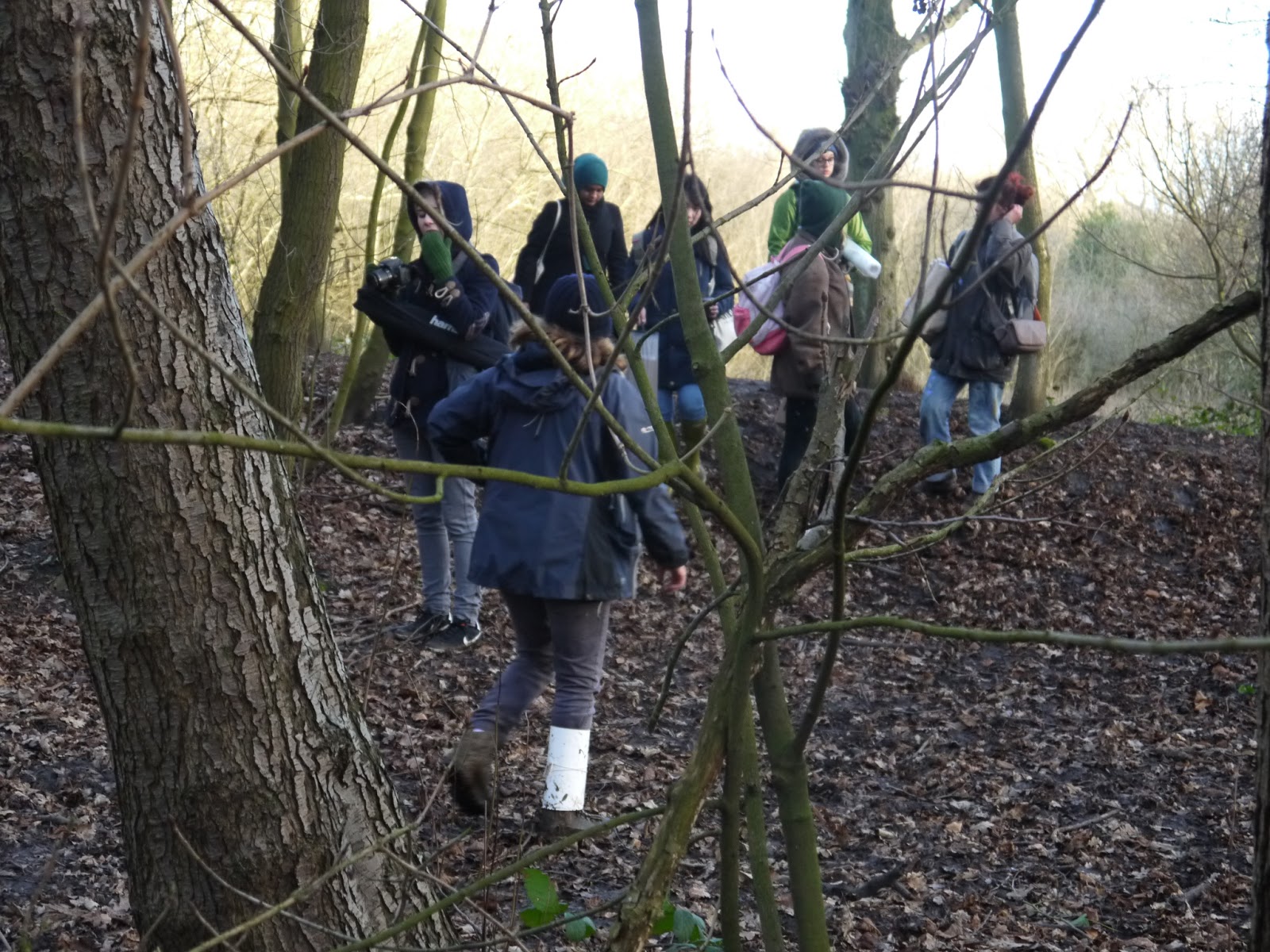
Setting out from E&C to Hampstead, loaded up with equipment.
Trailing through the mud and trees.


Inside the tree, great for relief printing and rubbings
Inside the tree.


It's all part of the process
Soaking in a mud pool
Paprika & Mud prints

 drying prints

What can the wind do?

Clay soil mix
Blotting paper and mud relief prints (leaves)

Plasterzine casts from memorial benches

Dipped in mud
Gatter/mud gauge/making the path

Home to bath!


Group marking


The wind is a mighty force

"The main difficulties was with the weather; 
the cold and the wind. It was hard to make a 
'clean & neat' print."
(Nadine)